November 4, 2026

In a Hurry?
- The Shift: With new digital tools, polish is easy and cheap. Care and attention to detail are now what sets your brand apart.
- What Care Looks Like: Today, care means expertise, ownership, and thoughtful consideration of intention, target result, and user experience.
- The Solve: Establish a marketing review process for your collateral (aka: marketing materials). Pause before publishing to make sure your content is authentic, accurate, and helpful. (We’ve built a worksheet to help you get started.)
Polish Is Now the Minimum
Small businesses are creating marketing content and design materials using AI-based and AI-supported tools more and more often. And it makes sense.
Chiropractors are incredible with spinal alignment. But when they also need to design a print ad for a local promo, an area likely well outside of their normal scope, turning to AI is a quick and easy solution.
At first glance, that AI ad is shiny. It feels real. But what happens when you look just a bit closer?
More often than not, that crisp, polished piece ends up feeling more like a plastic plant.
The Issue with Lack of Care in Marketing Materials
Once upon a time (and by once upon a time, we mean within the past few years), polish meant effort, expertise, authority:
- Grammatically correct copy meant a language expert was paying attention.
- Messaging touching on pain points and benefits meant deep familiarity with both the product/service and the customer.
- Consistent use of fonts and colors meant understanding of and adherence to brand guidelines.
- Use of text hierarchy meant an understanding of design as a visual roadmap.
Polish is still relevant—a requirement, even. A sloppily copy/pasted proposal means you’re likely looking at a shoddy business offer. An email full of typos and mismatched fonts is a standard warning in cybersecurity trainings.
Now, though, a quick AI prompt can generate decent copy that checks all those boxes for shiny copy. An AI tool can generate a design that looks presentable at a glance. Polish is easy now, the new baseline expectation.
When polish is the minimum, we scroll a sea of sameness. Marketing outputs all start to sound identical, taste like corporate cardboard—or worse, start to feel cheap and fake.
And that empty polish, coupled with a lack of original, experienced authority, can have real revenue implications for small businesses. For example, since businesses started using AI for marketing, 62% of UK consumers say they now trust marketing content less. This same 2026 report found 72% of consumers said they’re more likely to engage with content that feels human-created. And this engagement is a critical step in the revenue funnel. (More on this in our upcoming article about what fast AI content costs small businesses.)
In our experience, a specific, accurate, and authentic piece, even if it may look or sound a little plain, often lands better than one that’s hyper-polished but generic.
When you look just a bit closer, that crisp, polished piece ends up feeling more like a plastic plant.
What Does Care Mean in Today’s Marketing?
Let’s define. For our purposes, care means attention to detail, expertise, ownership. And a big part of attention to detail is thoughtful consideration of a marketing piece’s intention and the user’s experience with it.
Human-created or AI-produced, the audience can still feel whether someone was actually paying attention to the output. Attention to detail now means specificity, accuracy, follow-through.
A tool can match a voice or brand guide fairly well at this point, and it can get the bulk of the details mostly right. But it doesn’t necessarily know whether what it generated is true of your business, industry, client base, or ideal prospect.
And it’s important to remember that the tool’s goal is execution of the task—not commitment to efficacy or results.
What Does Care Look Like?
Care and attention to detail show up in every aspect of marketing, not to mention in sales and operations. And care—and lack of it—can take many forms. Here are just a few examples.
What Care Looks Like (Things Polish Can’t Fake)
- Noticing what’s missing (What question wasn’t asked? What context was missed? What’s off about the numbers?)
- Specificity from knowing the business intimately (e.g., knowing when to replace an image or word choice, a pain point, a position)
- A designated follow-through plan (Do we have an email follow-up in place? Who is double-checking account info in the CRM?)
- Restraint and integrity in outreach and message (e.g., knowing when to send that cross-sell promo email and when to hold off)
- Accuracy (Is this claim true of our product/service? Does this image make sense for our business/industry?)
Example: While researching social media scheduling tool options for a client, we came across a brand that shared a comprehensive breakdown of their tool vs. competitors. The brand acknowledged inherent bias upfront and recommended their competitors for situations where their own product might not meet the users’ needs.
What It Looks Like When Care Is Missing
- The collateral is technically correct but generic. It can be used pretty much as-is for any brand, including your competition.
- Details are slightly off. This can be for your industry, for your geographic region, for a specific customer/contact, or something that just doesn’t make sense timing-wise for your business.
- Posting is automated through an AI workflow, but no human is in the loop with a critical eye approving the content/design first.
- The collateral includes incorrect claims no one fact-checked. (AI can be both confident and wrong.)
Example: We were reviewing a proposal a vendor sent to one of our clients. It was way over-scoped, which suggested the vendor hadn’t dug deeply into the client’s specific needs. And, worse, the proposal had a different prospect’s name peppered in amongst the client’s business name mentions. One can be explained away as a typo or oversight—but multiple instances feel sloppy and careless.
Where Care Matters Most
Small businesses have to be incredibly nimble and intentional. Owners wear a closet full of hats and manage budgets that need to be able to stretch thin but strong. There’s often not a lot of time or budget to spare.
To maximize your effort, put the bulk of your attention on your highest-stakes touch points for prospects or current clients. Think: First responses to website forms, client proposals, and your website (especially the homepage).
Some areas to focus on:
- All aspects of customer-facing, trust-critical areas — Anywhere a misstep would be hard to undo
- Marketing messaging timing and accuracy — Ensuring messages match what your business can actually deliver, both as far as your product/service and your capacity to handle an influx of leads (Check out our Operational Readiness Checklist for more on this.)
- Operations — Confirming there’s a clear follow-up, handoff, and onboarding plan in place once an inquiry comes through
- Positioning — Being specific about who your product/service is for vs. not for
- Branding — Your brand is your identity. Close enough isn’t okay here.
- Customer Service/Sales — Anything relational should be human-first.
Who Is Responsible for Care?
The ideal marketing material reviewer is someone who can be objective. Someone who understands the material but didn’t produce it.
The creator is often too close to the material to be a final approver. If you wrote it, for example, you know what you meant to say. Your brain might be filling in context and details that aren’t on the page—and that might be critical for someone reading it cold.
For best results, you need someone with expertise, ideally across both marketing best practices and your product or service. Someone who can review the work and critically evaluate it before it goes to print or gets posted.
AI can create content that looks and sounds pretty good. But what’s not replaceable or automatable is the specificity, follow-through, and lived experience of your expert approver.
All businesses and all teams are different. Who the approver is might look different depending on how your business is structured, and you might need multiple approvers depending on your business size or product complexity.
Setting Up a Marketing Review Process
- Identify your highest-stakes assets. (See above for examples)
- Assign an owner/approver for each asset. This person will be in charge of making sure the material is accurate across messaging and design. Ideally, this person should also confirm that the timing of the marketing push matches your business’s operational capacity.
- Build in a pause for review and approval before publishing any marketing collateral. You’re looking for care: Is it specific? Accurate? Are we prepared for follow-through?
Your review process can often be handled internally. But if no one on your team can review with both fresh eyes and marketing expertise, you might want to consider outsourcing the final review—especially for the assets you’ve identified as highest-stakes.
The important thing is to get a process in place for marketing collateral review as soon as possible—and adhere to it. The specifics of your process will be unique to your business, but we’ve built a worksheet to help you get started.
Some Important Notes
Establishing this marketing review process means the whole team needs to be open to respectful questions and pushback from the approver. And, critically, the approval process must apply for all platforms and employee content at all levels.
A CEO posting hollow, AI-generated thought leadership content on LinkedIn can undercut brand trust the same way that careless proposal from our example did. The prospect is left wondering about your reliability and depth—and how carefully you’ll treat what they entrust to you.
Polish might be enough to get a prospect through your door, but they will remember whether they felt cared for.
Care Is a Practice
Your brand is the display window of your business. It deserves more than a cheap plastic houseplant.
Taking a few minutes to slow down before marketing materials go out is insurance against potential degradation of trust in your business.
Polish might be enough to get a prospect through your door, but they will remember whether they felt cared for.
If you could use some support identifying your highest-value marketing collateral or outreach channels, or if you need an extra set of eyes on the materials you’re producing, get in touch. We’re here to help!
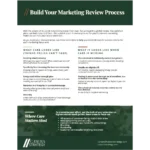
Marketing Review Process Worksheet Download
View the downloadable worksheet by clicking here or on the thumbnail below.